


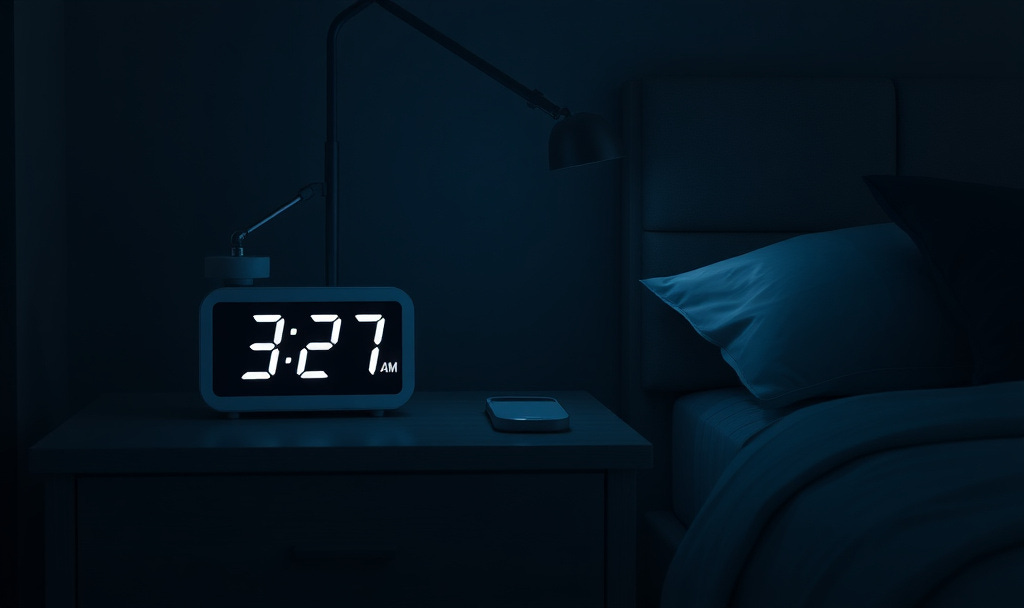
It’s 3:27 a.m. and I’m still tossing and turning in my bed.
The anxiety builds as I realize today is going to be a tough one. I have too many meetings today to feel this bad.
I know from experience that not sleeping the night before turns me into an anxious zombie that sees threats everywhere. My chest is tight and I feel like I can’t take a deep breath all day. My mind is slow to react in conversations. I really can’t connect with people.
This is the sleep-anxiety paradox: You need to sleep to feel calm and grounded. But you can’t sleep when you’re anxious.
And for those of us with anxiety, it is a special kind of hell.
I used to treat anxiety and sleep as two separate issues. It took me a long time to realize they’re interconnected, each affecting the other.
If you’re an anxious person, you’ve probably spent a lot of time trying to keep it at bay with meditation, journaling, yoga, and supplements. And we still ignore the single most effective and natural anxiety medication: 7–9 hours of sleep.
It’s not always easy. But it’s the foundation everything else sits on.
The Alarm System Without Brakes
If you’ve read my previous posts, you know I talk often about our “internal alarm system” (the ygdala).
This is the ancient part of your brain designed to keep our ancestors safe from saber-tooth tigers.
When it senses danger, it dumps adrenaline and then cortisol into your system to get you ready for fight or flight.
We also have the CEO part of our brain, the prefrontal cortex (PFC). This is the logical, rational part that can look at the situation and say, “Hey Alarm System, this is just a meeting invite from your boss. You can quiet down. We are safe.”
When you are sleep-deprived, your CEO goes offline.
Research suggests that when you’re short on sleep, the link between your prefrontal cortex (your CEO) and your amygdala (your alarm system) weakens. The alarm system takes the wheel, and it’s harder to hit the brakes—so small stresses feel like threats.
This is why after a bad night of sleep, the world feels sharper, louder, and more dangerous.
For me, I often feel like I’m on edge the entire day and this means I don’t show up in the world as I’d like. I’m shorter with people, stuck more inside my body and my mind, and have trouble connecting.
It’s like we’re driving a car with a brick mashed down on the gas and no brakes.
When Sleep Becomes a Performance
The pressure to sleep is often the thing that keeps you awake.
We’ve all been there. You have a big day tomorrow and you lay down in bed, knowing you need to sleep well to have a good day.
And then after 30 minutes, you’re still wide awake and now the pressure is mounting.
You know you have to be up at 6 a.m. and you’re doing the sleep calculation in your head.
If I fall asleep now, I’ll get seven hours of sleep.
30 minutes pass.
Damnit. I just want to sleep. If I fall asleep now, I’ll get 6.5 hours of sleep. Ok, not great but manageable.
30 more minutes pass.
This is not good. I know six hours of sleep isn’t enough. Why can’t I fall asleep?
An hour passes.
Oh my god, this is a nightmare. I’m going to be so tired and anxious tomorrow.
30 more minutes pass.
CAN I PUSH BACK ALL MY MEETINGS TOMORROW? CAN I CALL IN SICK? CAN I QUIT MY JOB? MAYBE I SHOULD BURN MY HOUSE DOWN AND COLLECT THE INSURANCE MONEY, MOVE TO THE BEACH, AND SELL SURFBOARDS? MAYBE I JUST DISAPPEAR AND GO LIVE IN THE WOODS FOR A WHILE?
You now have performance anxiety about sleeping.
The act of trying to sleep becomes a high-stakes event. Your brain releases adrenaline to “help,” which (of course) wakes you up even more.
It’s a vicious feedback loop and often we don’t realize we’re even in it.
Before you burn your house down and move to the beach, I have some suggestions for achieving better sleep and lowering your anxiety.
How to Engineer Better Sleep
The goal is to better prepare your mind and body to achieve deep sleep. This starts hours before you actually get in bed.
If you’re reading this while exhausted, here’s the good news: you don’t need a perfect routine. You need a few levers pointed in the right direction.
If you only do a few things, do these. Start with the one that feels easiest tonight.
Cut Out Lights & Screens
We’re all guilty of lying in bed at night and “just scrolling for a little bit longer.”
It feels harmless, but it keeps your brain “on” when you’re trying to power down.
Practical rule #1: If you can, cut screens 30–60 minutes before bed. If you can’t, dim them and keep them out of the bedroom.
Blue light from screens (your phone, TV, laptop) is disruptive to sleep. The light can delay melatonin production, which disrupts your circadian rhythm and makes it harder to fall asleep.
And it’s not just blue light. Bright indoor light at night can also delay melatonin and make it harder to drift off.
Darker is better. Pitch black is great if you can get it.
I don’t have blackout shades, so I started using a sleep mask. Once I’m out, I’m much less likely to wake up before my alarm.
Being mindful of the light that you encounter before bedtime can help you fall asleep faster and stay asleep.
No Eating or Drinking Before Bedtime
I had a bad habit in my 20s of eating before I went to bed. I wouldn’t be full from dinner and so 9–10 p.m. would come around and I’d have a bowl of cereal or a protein bar.
I had no idea that it was affecting my sleep.
Practical rule #2: Don’t eat a large meal at least 3 hours before bedtime.
Why?
Late eating and heavy meals are commonly linked to worse sleep quality and more awakenings (often because of reflux and your body staying “switched on”).
Digestion is work. Your core temperature can stay higher while your body processes food—right when you’re trying to downshift.
Snacks before bedtime can usually be fine, but they should be small, not spicy, and not acidic.
Alcohol
Alcohol can help you fall asleep (see: pass out), but it tends to increase nighttime awakenings, reduce REM sleep, and worsen snoring and sleep apnea.
This is why you can sleep for 7–8 hours after drinking and wake up still feeling terrible, like you haven’t slept. It worsens your sleep quality.
Practical rule #3: If you do drink, a best practice is to stop drinking 4+ hours before bedtime. (And I see you rolling your eyes. I know. I know)
Caffeine
Caffeine is a frequent hidden driver of insomnia and anxiety symptoms at night. Many people don’t think about how much caffeine they consume in a day, let alone when.
Caffeine actually blocks adenosine, a key neurotransmitter and natural sleep-promoting substance (the “sleep drive”).
Studies have shown that caffeine 6 hours before bedtime still significantly disrupted sleep.1
Practical rule #4: try to make your last caffeine noon–2 p.m. (Not perfect. Just better.)
Cool Down the Body
About 1–2 hours before sleep, your core body temperature naturally starts to drop. That drop is part of what helps you fall asleep.
Your body needs to drop by a few degrees to successfully initiate sleep.
If your room is too hot, your body struggles to cool down, which can make it harder to fall asleep or stay asleep.
Many sleep clinicians and organizations recommend 60–67 degrees Fahrenheit (15.5–19.5 degrees Celsius) as a practical target for adults.2
If you don’t have a thermometer in your room, here’s a way to gauge if the temperature is ideal:
Practical rule #5: Aim for a bedroom “cool enough that you want a light blanket,” but not “cold enough that you’re shivering.”
I actually can’t sleep without fans on. I have a ceiling fan and a Dyson cool fan pointed on me as I sleep. Yeah, I’m that guy.
Are you setting your body up for deep sleep?
Prioritize the Foundation
If you’re struggling with anxiety right now, take a look at your sleep. You now know it can have a large effect on your nervous system.
Are you giving your CEO a chance to come online? Or are you running purely on Alarm System energy?
Sleep isn’t just about feeling rested. It’s about emotional regulation. It’s about having the resilience to handle everything life throws at you.
What’s the one sleep habit sabotaging you right now—and what’s one small change you’ll try tonight? Let me know in the comments.
Next Week—What To Do When You Can’t Sleep (3:27 a.m. Protocol)
Next week, I’ll share my 3:27 a.m. protocol—what to do (and what not to do) so you don’t spiral and you give your body a real chance to fall back asleep.
Sleep tight!
Great tips, Andy.
It reminds me of the time, in my 20s, when I was unable to fall asleep and I'd be up ALL night *trying* to zonk out. My therapist at the time gave me as assignment: buy a TV (I didn't have one) and make sure I'm up all night watching it; falling asleep was strictly forbidden. Well, you can guess how that turned out. The monkey was off my back, and I snoozed like, well, a 20something.
Today, my issue is *staying* asleep. I awaken between 1 and 3am and can't get back to sleep. Anyway, I'll try your tips, particularly "doom scrolling" in bed (duh...) and no big meals prior to snooze time. Thank you.
Good read and got Brett and I talking about anxiety and how it shows up for each of us. Going to start with screens going off at our house before bed so will see how that helps.